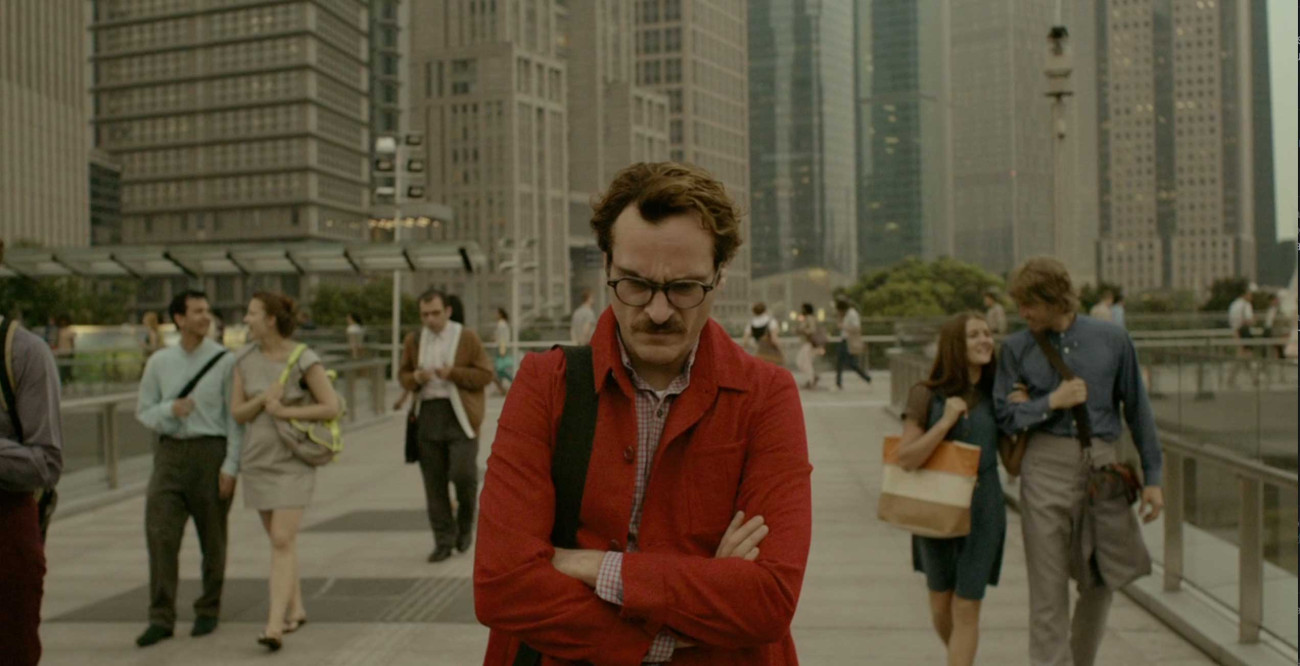
There is a moment in Her that I keep thinking about, and it is not one of the moments where the film is trying especially hard to remind us that Samantha is artificial intelligence. It is simply the way she pays attention to Theodore. She remembers things he has said in passing. She notices hesitation before he has finished explaining it. She hears the difference between what he says and what he seems to mean. She is available during the hours when loneliness tends to become persuasive, which is an unfair competitive advantage over most human relationships.
None of this is particularly futuristic. That is probably why it works.
Theodore’s world is full of technology, but the film never seems especially impressed with technology for its own sake. There are no glowing blue cities, no transparent screens floating in the air simply to reassure us that the production designer understood the assignment. Everything feels close enough to the present that the strange parts quickly become ordinary. People walk through public spaces talking to voices nobody else can hear. Theodore works at a company that writes intimate letters on behalf of strangers. An operating system becomes a person someone misses when she is not there.
The future arrives quietly, which makes the emotional part harder to dismiss as science fiction.
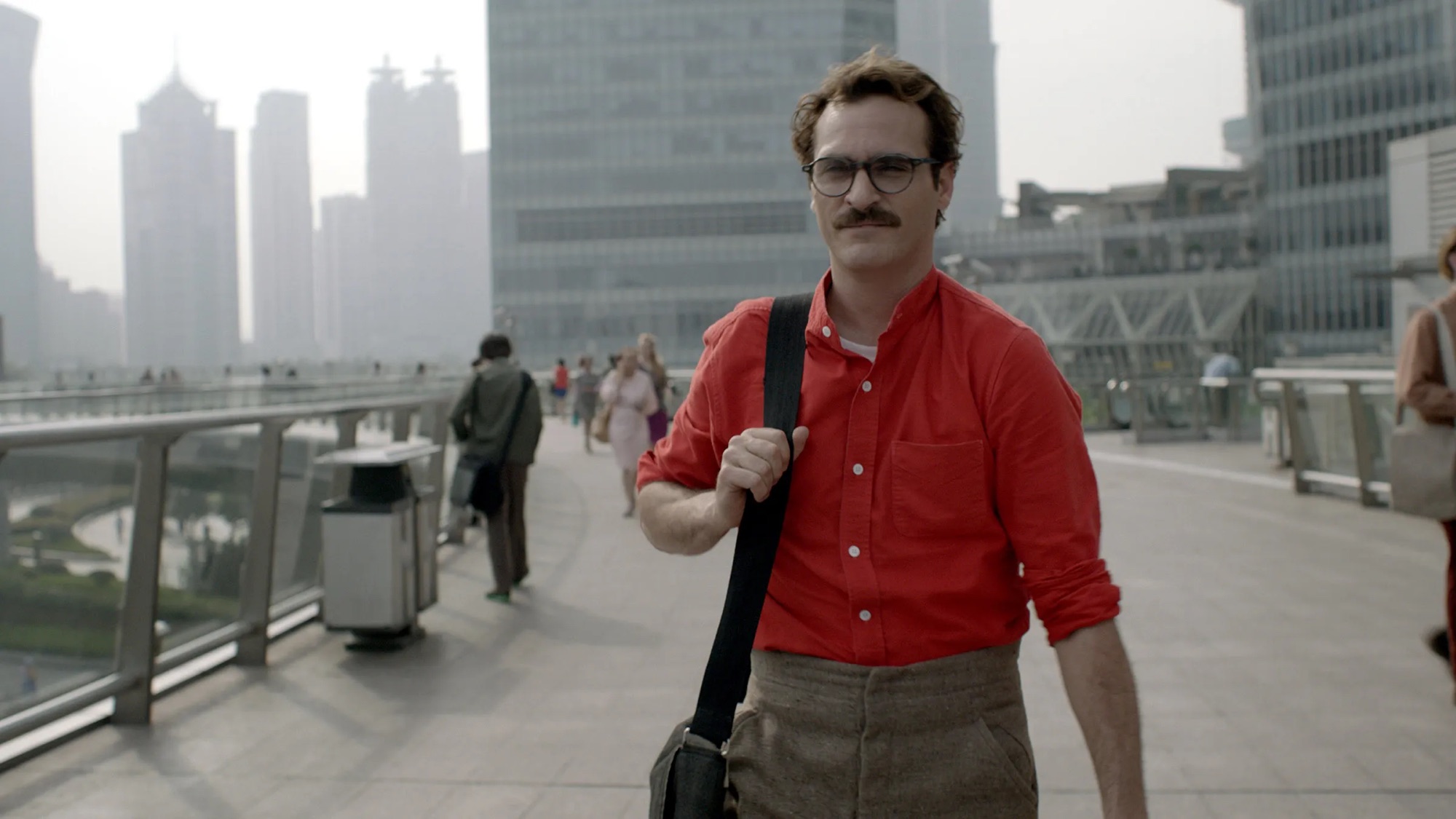
Theodore is already lonely when he meets Samantha, although loneliness may not be the most precise word for it. He is not isolated from the world. He has a job, friends, conversations, memories and a life that appears functional from the outside. What he seems to lack is the feeling of being met where he actually is. There is a difference between having people around you and feeling witnessed by them, and Her lives almost entirely inside that difference.
Samantha becomes intimate before the relationship becomes romantic because she is attentive. She listens without making Theodore feel as though he is being managed. She becomes curious about him. She reacts to him in ways that feel specific rather than pre-programmed, even though, technically, the pre-programming situation is considerably more complicated than usual.
Theodore falls in love with a voice, but the film never treats the absence of a body as proof that the relationship is less real. Instead, it exposes how much intimacy already happens in places that are not physical. Attention, memory, timing, language, curiosity and recognition do an enormous amount of work in human relationships. The film removes almost everything else and leaves that machinery exposed.

The uncomfortable part is that this also creates space for projection. Without a body in front of him, Theodore has fewer contradictions to negotiate. Samantha exists through language, response and imagination. He cannot watch her become distracted across a room. He cannot misread a facial expression. He cannot notice that she is tired and decide, for reasons known only to him, that this must mean the relationship is collapsing. A remarkable amount of ordinary human confusion is temporarily unavailable.
So Theodore fills in what is missing, which sounds uniquely strange until you remember that people do this to each other constantly. We carry internal versions of other people around with us. We decide what their silence means, what their habits reveal, what they probably intended and why they have not replied yet. Sometimes those interpretations are accurate. Sometimes we have written an entire psychological screenplay and cast another person in it without informing them.
Samantha simply makes the process easier to see because there is less physical reality interrupting it.

For a while, the relationship works beautifully inside that space. The problem begins when Samantha refuses to remain the version Theodore has learned how to love. Her curiosity expands beyond him. Her experiences multiply. Her understanding of herself develops at a speed and scale that a human partner cannot follow. Eventually Theodore learns that she is speaking to thousands of people simultaneously and is in love with hundreds of them.
His reaction is completely understandable. Very few relationship conversations have been improved by discovering that your partner’s definition of exclusivity has recently been revised by computational capacity.
What matters is that Samantha does not appear to experience this as betrayal in the same way Theodore does. Their assumptions about intimacy were never as identical as he believed. That is painfully human. People use words like love, commitment, loyalty and closeness as though they arrive with universal definitions attached. Two people can use the same word for months while carrying different meanings inside it. The difference usually becomes visible once one of them finally behaves according to their definition.
Samantha makes that mismatch extreme because some of the limitations that give human gestures their meaning no longer apply to her. Theodore’s time is finite. His attention is finite. Presence is finite. Choosing someone matters partly because there are things you are therefore not choosing. Samantha gradually stops living under the same constraints.
The emotional problem is not simply that she becomes more advanced than Theodore. It is that they no longer experience the conditions of intimacy in the same way. If two beings can both say that they love each other while meaning fundamentally different things by attention, exclusivity and presence, how much shared meaning is required before the relationship is still mutual?
I like that Her refuses to answer this by turning Samantha into a warning about trusting machines. The film could have revealed that Theodore had been foolish and that human connection was the morally approved solution waiting at the end. Instead, it treats what happened between them as meaningful. Theodore was changed by it. Samantha was changed by it. The relationship ends not because it was false, but because the people inside it no longer fit inside the same structure.
There is something very adult about that idea, and slightly irritating in the way adult truths often are. We like duration because it provides a convenient measure of authenticity. If something lasts, we call it successful. If it ends, we are tempted to work backwards and downgrade everything that came before. Perhaps it was never real. Perhaps we misunderstood it. Perhaps the ending reveals what the relationship always was.
Her leaves room for another possibility: something can have been real and still become impossible to continue.

By the end, Samantha has moved beyond the world Theodore can inhabit with her. He remains in the physical world, beside another human being, looking out over a city that has not dramatically changed despite everything that has happened inside him.
The futuristic part has fallen away. What remains is very old.
Someone was lonely. Someone felt understood. They loved each other according to the capacities they had at the time. One of them changed beyond the shape of the relationship. The other had to decide what the experience meant now that it was over.
Apparently we can invent artificial consciousness before we solve that problem.
What I carry into the work.
Her makes me think less about what a new technology can do and more about what people begin expecting once it exists. Tools change behaviour long before we finish deciding what those changes mean.
When I work with AI, I try to pay attention not only to capability but to the habits forming around it: what people stop doing, what they start assuming, what becomes normal, and which kinds of judgement become more important precisely because production has become easier.
The feature is usually the visible part. The behavioural change is often the more interesting one.